
The “stages of change” model is one of the foundations of a psychological approach. The model can be useful for working out what resources you, your group or organisation might need at this point in time.
At Psychology for Ecology we hope to offer or suggest a range of resources to help people at different points on this cycle to engage with the ecological crisis.
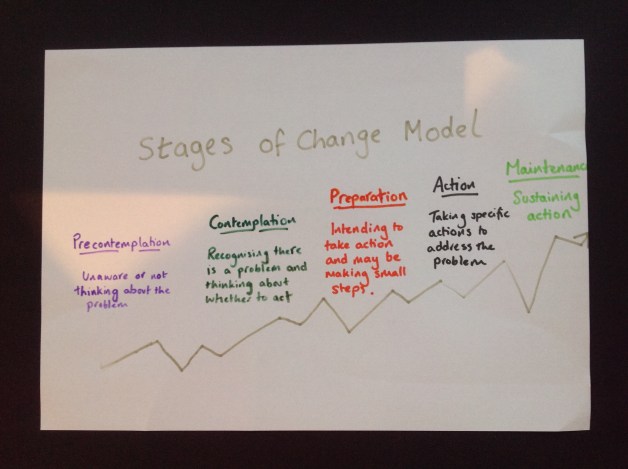
Precontemplation stage
When we are underinformed about, or avoiding thinking about the ecological crisis.
This stage requires both information and safe spaces to explore our responses to new knowledge. At Psychology for Ecology we have a library, and I work with Love Co2mbe Down to put on local film nights, talks, and local community projects to begin or enhance engagement with the issues of climate change and ecology.
Contemplation stage:
When we recognise there’s is a problem and are thinking about whether or how we can act. Many people get stuck at this stage, feeling disempowered or overwhelmed by the emotional impact of facing the crisis.
We can offer training to facilitate a greater engagement with the issues. Aiming to help resolve inner conflict and dilemmas, by allowing the expression of feelings such as grief, anger, fear, guilt and hopelessness and thoughts provoked by thinking about these issues. Liberating change can occur through exploration in a supportive and safe environment and by using exercises and practices which facilitate emotional processing, new perspective taking, connecting to values and committing to action. This might include mindfulness, imagery and visualisation, use of metaphor, life narrative telling and written or art based exercises. Workshops are based on Joanna Macy’s ‘work that Reconnects’ and also draw on psychotherapeutic models such as ‘acceptance and commitment therapy’
Preparation stage:
Intending to take action, committing to action and overcoming obstacles to action. We work at this stage usually in the same workshops as for the contemplation stage described above. This is usually group work but ad hoc individual sessions can be booked for specific needs. Our groups create safe spaces to reflect on ideas and recognise skills and sources of support, and help to work through psychological obstacles (emotions, beliefs, trauma) that can lead to lack of confidence, fear of failure, or interpersonal anxieties. The aim is to enhance psychological and interpersonal resources and increase the resilience of the individual or groups so that they can feel freed up towards planning ecologically focussed action and change, either in their personal life or the community or broader systems.
Action stage:
The action is likely to take place elsewhere (!) but we can provide a community hub at 175 to network, use resources such as the library, gain advice and encouragement from others. If you’re interested in using 175 as an eco work hub, please contact me as I would like to gain a sense of the demand for this. We wish to support activism in all it’s many and varied forms, be it writing, community projects, protest and direct action, organisational change, political activism, or conservation and regeneration projects.
Maintenance stage:
For those engaged in activism and social and ecological change we wish to offer support to relieve burnout, with processing of trauma that has occurred in the course of activism, and with interpersonal difficulties affecting the work. Workshops in ‘the Work that Reconnects’ and other approaches can be offered specifically to activists.
 Psychology for Ecology